
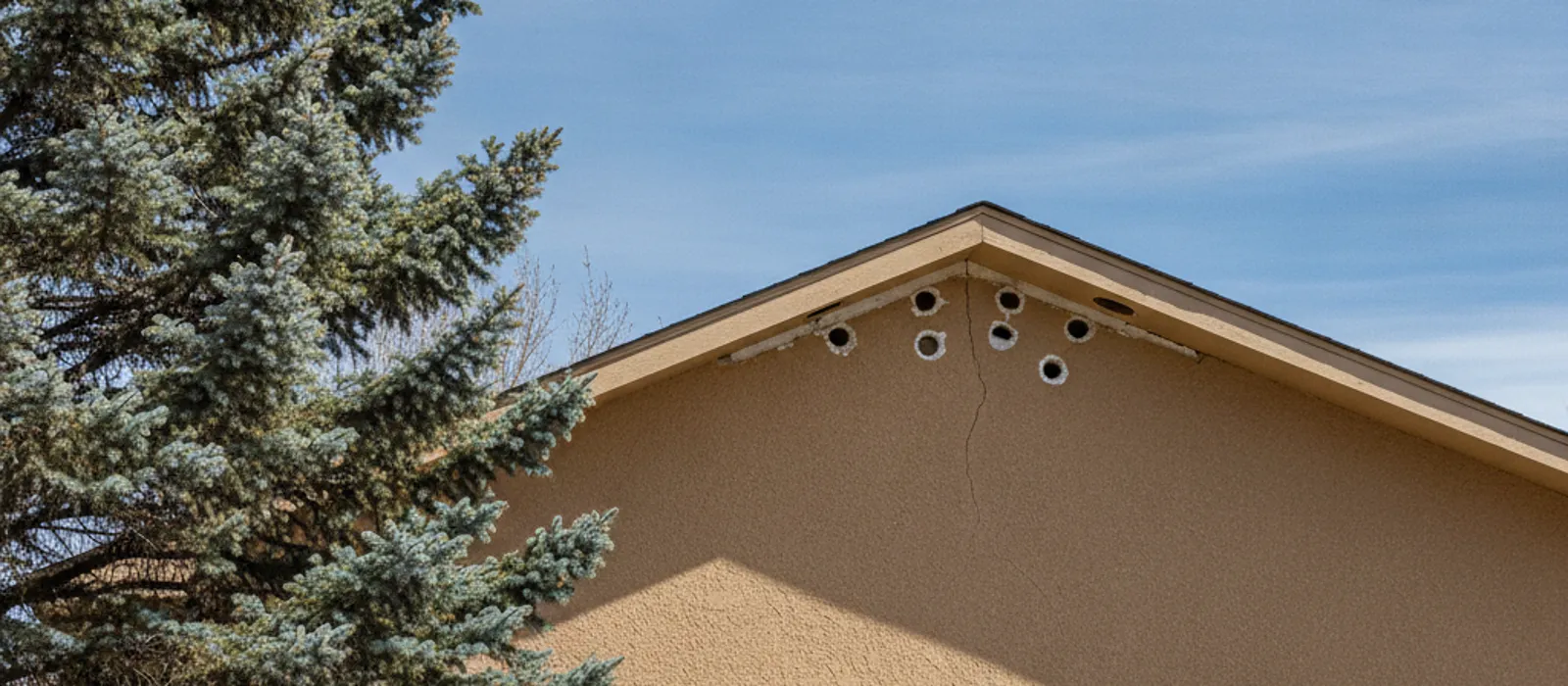
A northern flicker that keeps drilling the same spot on your wall leaves you with two problems. How do you stop the bird, and when are you allowed to fix the hole? One Calgary contractor, Calgary Parging, lists a typical single-woodpecker patch at $600 to $800. An open hole is also a gap in the wall’s defence against water, which is why it is worth dealing with once the law allows.
This guide covers what the law lets you do, how to discourage the bird, what a repair involves, and what Calgary firms publish for the work. It’s meant for a homeowner who wants to make one sensible call, not study a manual.
This page is an advertisement. Independent Calgary stucco contractors pay this site to be introduced to homeowners. The site does no repair work, and the contractor who quotes your wall contracts directly with you.
Photograph the holes and describe the wall through the quote form. An independent Calgary stucco contractor can then send you a written quote after seeing the damage. If you would rather talk, the number is (403) 555-0148.
Why a flicker drills woodpecker stucco walls
You can’t always tell from the outside why a bird picked your wall, or whether a hole is feeding damage or the start of a nest. That second question matters, because the law treats an active nest very differently from an empty hole (more on that below).
Calgary Parging says: “Flickers work Calgary stucco hard, especially on west and south elevations in spring.” That comes from the firm’s own jobs, not a survey, so use it as a hint about where to look first.
The same firm explains why some walls get hit harder. Woodpeckers go for EIFS (the foam-backed, thin-coat system), it says, because “the foam insulation behind the finish is much softer than concrete, and tapping on it produces the hollow resonance” birds associate with insects. If you’re not sure which system your house has, the EIFS versus stucco guide shows how to tell them apart.
Calgary Parging also said in 2024 that cement stucco with an acrylic finish is the main product on over 87% of residential properties, based on its own job mix. On that firm’s figures, foam-backed walls are the smaller share, but they are the ones it singles out as a woodpecker target.
How deep the hole goes matters more than how wide it is. A mark that stays in the finish coat is a smaller job than a hole that reaches the building paper or sheathing behind it.
What the law says about a flicker hole
The northern flicker (Colaptes auratus) is a migratory bird protected under the federal Migratory Birds Convention Act. Section 5(1) of the Migratory Birds Regulations, 2022 says a person must not capture, kill, take, injure or harass a migratory bird, or disturb an egg or a nest, without a permit. The full text is on the Government of Canada’s justice laws site.
In plain terms:
- Don’t trap, poison, shoot or chase a flicker. Harassing it counts.
- Don’t touch a hole that has a live bird or an egg in it. Wait.
- An empty hole, with no live bird and no viable egg, may be removed or repaired without a permit under s 5(2)(b). The only woodpecker in the regulation’s Schedule 1, whose nests get longer protection, is the Pileated Woodpecker. The flicker isn’t listed.
- Non-harmful scaring is allowed. Section 63(1) lets a person, without a permit, use equipment other than an aircraft or firearms to scare migratory birds that are causing damage to “environmental or other interests”.
Environment and Climate Change Canada’s FAQ on the 2022 regulations says you may take measures to discourage a bird from nesting again in the same spot, as long as they do not disturb or harm it. Its example is covering the area with a tarp or wire mesh. Anything beyond that, such as removing a nest with eggs in it, needs a federal permit. That is not a job for a stucco contractor, or for a homeowner with a ladder.
So: confirm the hole is empty and the bird has finished, then repair. If you can’t tell, ask the contractor to check before any work starts, and don’t pack the hole in the meantime.
Discouraging the bird without harming it
ECCC’s guidance is about stopping a bird from nesting in the same place again, and it makes sense to sort that out before the repair. Otherwise the fresh patch sits in the spot the bird already chose.
Options that stay inside the rules:
- Cover the spot. ECCC’s own example is a tarp or wire mesh. On a wall, that usually means mesh or a similar barrier fixed over the damaged area while the bird isn’t using it. Ask the contractor what can be fastened to your wall without opening new gaps for water.
- Scare devices. Section 63(1) allows scaring equipment other than aircraft or firearms, provided it doesn’t harm the bird. We found no source showing that any one device works reliably on flickers, so treat this as an experiment.
- Repair after nesting ends. Patching while a bird is still working the spot risks it being drilled again. Waiting until the bird has gone lowers that risk.
The rules are built around not harming the bird, so anything that traps, injures or distresses it is out, however clever it sounds. If a product or a person promises to “get rid of” woodpeckers, ask exactly what they will do to the bird.
If the hole is at the second storey, both the cover and the repair need access. That can mean a ladder, a lift or scaffolding, which is one more reason to leave it to a contractor.
Woodpecker stucco repair: what the work involves
Calgary Parging’s published price is for a patch plus reinforcement, which tells you a proper repair is more than a dab of filler. Exactly what that involves on your wall is for the contractor to spell out in the written quote.
On traditional cement stucco, Imasco, a Surrey, BC stucco manufacturer, specifies a scratch coat of at least 10 mm, then a brown coat bringing the system to 19 mm. Ask the contractor how the patch will be built back through those layers.
On foam-backed systems, the contractor also has to deal with any insulation the bird has dug out, and water that has reached the sheathing changes the job. Calgary Parging says: “Stucco is designed to deflect water, not to be waterproof. The layer that actually keeps water out of your home is the building paper behind it.” If the bird has gone through the paper, the paper is part of the repair.
Before the quote arrives, it helps to know two things.
The wall may be worse than it looks. Calgary Stucco and Slate, another Calgary firm, says: “Nobody can tell you the full extent of water damage until the wall is opened up.” A quote for a single patch is a starting point, and the contractor should say in writing what happens to the price if the sheathing has to be replaced. Calgary Parging lists water-damaged sheathing replaced first at an added $575 to $2,300 or more, before GST.
The colour may not match. Imasco says: “Variations in colour may occur due to weather, texture, job conditions and method of application,” and advises buying the same colour batch number for the complete job. Calgary Parging notes that cement and acrylic finishes “age and weather differently”, and that on a heavily weathered finish a perfect match may not be achievable, in which case refinishing a full elevation is the option. Martini Stone Masonry adds that matching an aged finish takes trial batches. Ask how the patch will be matched, and what happens if it still shows.
What Calgary firms publish for woodpecker stucco repair
There’s no single Calgary price for a woodpecker patch. Each figure below is one firm’s own published number, from different pages and dates, so don’t average them. Use them to judge whether a written quote is in a sensible range for your kind of wall.
| Source | What it prices | Published figure | GST |
|---|---|---|---|
| Calgary Parging (woodpecker page) | Typical single-woodpecker patch plus reinforcement | $600 to $800 | Not stated |
| Calgary Parging (April 2024 list) | Woodpecker patch, 1st storey / 2nd storey and up | $600 / $800 | Not stated |
| Martini Stone Masonry (repair page) | Woodpecker damage on EIFS, per hole | $250 to $350 | Not stated |
| Calgary Parging (repair cost guide, May 2026) | Small patch repairs (chips, cracks, colour match) | $550 to $1,125 | Before GST |
| Calgary Parging (same guide) | Colour match, added to a repair | $230 to $575 | Before GST |
| Calgary Parging (same guide) | Water-damaged sheathing replaced first, added | $575 to $2,300+ | Before GST |
| Calgary Parging (same guide) | Scaffolding for upper-storey or peaked sections | $4,000 to $12,900 | Before GST |
Two cautions. Martini’s per-hole figure is for EIFS and comes from its main repair page, which uses different numbers from its separate cost page, so don’t combine the two. And the scaffolding line is for larger upper-storey work; it doesn’t mean every second-storey woodpecker patch needs scaffolding. Ask the contractor whether access is in the quote, and what it costs if not.
Calgary Parging’s guide says most repairs take 1 to 3 days, depending on scope and weather. That describes the firm’s own work, not a promise about yours.
One first-storey patch and a wall full of holes are different jobs. The next section shows how far apart the numbers can land.
Three walls, three scopes
These are hypothetical examples built from the published figures above. They are not customer stories, and your wall will differ.
A flicker returning to the same gable every spring. The hole is near the peak of a two-storey gable on a west-facing wall. Calgary Parging’s April 2024 list puts a second-storey woodpecker patch at $800. The bigger questions are access and keeping the bird off. The homeowner asks the contractor to quote the mesh cover and the patch together, and to say whether access is included.
A foam-backed wall with six holes at first-storey height. On an EIFS wall, Martini publishes $250 to $350 per hole, GST not stated, so every hole is priced on its own at that firm. That is one firm’s range, not a quote. The holes may share a hidden problem, so the homeowner should ask whether the foam behind each one has been checked for damp before the surface is closed.
A hole with a soft edge under a bedroom window. The bird has drilled below a window, and the stucco around the hole feels spongy. This is a different job. Weststar Wall Systems lists soft or spongy areas as a warning sign, and Calgary Parging adds $575 to $2,300 or more, before GST, when sheathing has to be replaced first. The homeowner reads the moisture behind stucco guide and asks for a written scope that says what will be opened up.
Getting a written quote and checking the contractor
Alberta.ca advises you to insist on a written contract and to get written estimates from more than one business. It also says to make sure the contractor and tradespeople have Workers’ Compensation Board (WCB) coverage. Ask to see proof.
Checks that suit a woodpecker repair:
- The scope names the materials and the work. For prepaid contracts over $200, Alberta regulation AR 185/99 s 10 requires the contract to set out the quality or types of materials and the work to be carried out.
- A door-to-door contractor may need a prepaid contracting licence. A contractor who takes money before the work is finished, and who solicits, negotiates or concludes the contract in person away from its own premises, needs one (AR 178/99 s 5). You can check with Service Alberta.
- You may be able to cancel. Under Consumer Protection Act s 27, a consumer may cancel a direct sales contract (one negotiated or concluded at the home, for example) without any reason until 10 days after receiving a copy of the written contract.
- The City of Calgary requires a business licence. Call 311 to confirm the contractor has a valid one.
- Stucco is not a compulsory-certification trade in Alberta. The optional-certification trade that covers exterior finishes is Lather (Interior Systems Mechanic), so a missing certificate isn’t a red flag by itself. Ask what experience the contractor’s workers have on your kind of wall.
For a like-for-like repair, the City of Calgary says most repair or replacement work does not need a development or building permit. Confirm your own project with 311.
Then there’s insurance. The Insurance Bureau of Canada says hail and wind damage is typically covered by home insurance policies, but that statement doesn’t mention wildlife. Whether bird damage is covered depends on your policy, so read yours, and call your insurer before any repair work, as the City of Calgary advises. A contractor can give you a written repair estimate that you may pass to your insurer. If your home is newer, look at your new home warranty too. It covers defects, and whether a bird hole counts is for the warranty provider to decide, so don’t count on it.
Timing: what you can do in a Calgary winter
Find the hole in November and a proper repair probably waits for spring, or needs heated hoarding. Imasco says to perform no stucco work when the air and substrate are below 4°C, for 24 hours before, during and after application. Calgary Parging says stucco cures best above 5°C in dry conditions, typically April through October in Calgary, and that off-season repairs require heated hoarding.
That leaves winter for four steps:
- Photograph the hole and the wall around it, with a ruler or coin for scale.
- Note the date, the height, which way the wall faces, and whether you’ve seen the bird.
- Ask a contractor whether a temporary cover suits your wall. Don’t stuff a hole that could still hold a bird.
- Book the repair for the warm months, once the hole is empty and nesting has ended.
Photos taken now also help a contractor scope the job before the snow melts. If hail has marked the wall as well, the hail damage guide covers what to document. Both problems are covered on the hail and woodpecker damage page, and general repair information is on the stucco repair page.
Send photos of the holes and the wall through the quote form, and an independent Calgary stucco contractor can quote the repair in writing after seeing the damage. Phone is (403) 555-0148 if that suits you better.
Frequently Asked Questions
Is it legal to repair woodpecker holes in stucco?
Yes, once the hole is empty. Under the Migratory Birds Regulations, 2022, s 5(2)(b), a nest with no live bird and no viable egg may be removed without a permit, and the northern flicker is not in Schedule 1, where the only listed woodpecker is the Pileated Woodpecker. If a bird or egg is inside, leave the hole alone.
Can I do the patch myself?
For a small dent in the finish coat, some owners do. For a hole that goes through to the paper or foam, the layers, the flashing and the colour match all matter, and a poor patch can trap water. The DIY versus professional guide sets out where the line usually falls. Anything at the second storey is better left to a contractor.
How much does woodpecker stucco repair cost in Calgary?
It depends on the wall. Calgary Parging lists a typical single-woodpecker patch plus reinforcement at $600 to $800 (GST not stated), and Martini Stone Masonry lists $250 to $350 per hole on EIFS (GST not stated). Sheathing, access and colour matching are priced separately, so ask for a written scope.
Will insurance pay for woodpecker damage?
It depends on your policy. The Insurance Bureau of Canada says hail and wind damage is typically covered but does not name wildlife damage, so read your policy and call your insurer before any repair work. This site does not handle, file or negotiate insurance claims; that is between you and your insurer.