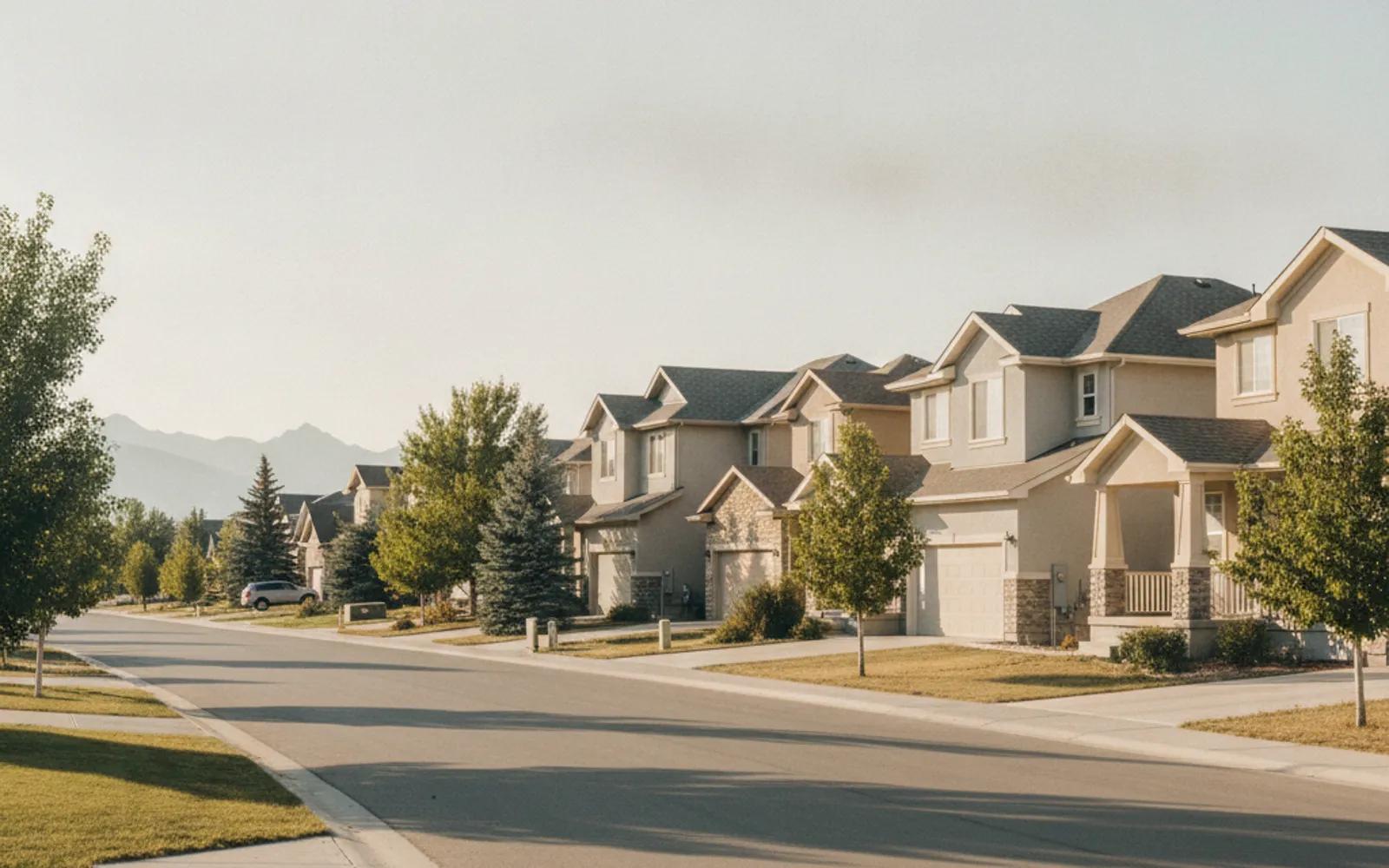
Stucco repair from Auburn Bay, Mahogany and Seton to McKenzie Towne and the 1980s and 1990s streets of Douglasdale and Riverbend. Tell us what you see on yours and an independent stucco contractor can quote it.
Stucco repair in Southeast Calgary covers a lot of newer housing. The City labels Auburn Bay, Mahogany, Rangeview and Seton as 2000s communities and McKenzie Towne as 2010s, and 2021 figures put 17,505 people in McKenzie Towne, with 62% of dwellings built 2001-2010 and 20% built 1991-2000. Older pockets such as Douglasdale/Glen, McKenzie Lake and Riverbend date from the 1980s and 1990s.
Sandstone Stucco Co is an advertising and introduction service, paid by contractors. It does no stucco work itself; the independent contractor who quotes your job contracts directly with you. If you have hail dents, a woodpecker hole, a crack at a window or crumbling foundation parging, start with the stucco repair overview or call (403) 555-0148 for a no-obligation quote.
Hairline cracks, chips, loose patches and gaps where stucco meets a window or door frame on Southeast Calgary stucco walls. The contractor also has to deal with colour matching on a finish that has weathered.
Hail dents and holes, and northern flicker holes on the wall. A contractor can give you a written repair estimate that you may pass to your insurer, and you call your insurer first.
Cracked or flaking parging on the exposed foundation wall above grade, from a patch to a full-perimeter recoat. Parging only: no foundation crack repair, waterproofing or structural work.
When damage is widespread or moisture has got behind the finish, a contractor may price a section, an elevation or a full re-stucco. The scope and price come after the wall has been looked at.
The City's 2021 figures show that 20% of Calgary's occupied dwellings were built 2001-2010 and another 9% in 2011-2015. The City labels Auburn Bay, Mahogany, Rangeview and Seton as 2000s communities. Calgary Parging, a local contractor, says cement stucco with an acrylic finish is its main go-to product on over 87% of the residential properties it works on, which is its own job mix and not a city-wide count.
Martini Stone Masonry, another Calgary contractor, says an acrylic finish stays flexible through freeze-thaw and resists hairline cracking better than a cement finish. Even so, the same contractor lists freeze-thaw cracking, snow piled against the wall softening the lowest 12-18 inches, and 3-8 mm gaps opening where stucco meets frames. Calgary recorded 117 freeze-thaw cycles in 2022 against a 30-year average of 128, and 54 chinook days against an average of 46, so walls here swing between cold and thaw often.
The City labels Douglasdale/Glen, McKenzie Lake and Riverbend as 1980s and 1990s communities. Martini Stone Masonry names the systems it meets on Calgary walls as conventional three-coat, Imasco or EIFS, and the contractor who visits will tell you which one is on yours. If your home is newer, check your new home warranty before paying for repairs. Homes built under a building permit applied for on or after 1 February 2014 have at least five years of cover for defects in the building envelope, but hail damage is not a defect.
The City of Calgary says the city sits in hail alley and that all communities within Calgary are equally exposed to hail. Environment and Climate Change Canada placed the 13 June 2020 hail core over northeastern Calgary, and the Insurance Bureau of Canada (IBC) says the 5 August 2024 storm primarily affected northern parts of the city. A Southeast address is not proof that your walls are fine, so look at them anyway. The City also notes that stucco holds up well to moderate hail, but severe storms can cause damage.
IBC says hail and wind damage is typically covered by home insurance policies, but stucco is not named, so check your own policy. Its steps are to assess and document the damage with photos, call your insurer or its claims department, keep damaged items unless they pose a health hazard, and keep all receipts. The City of Calgary adds that you should contact your home insurance provider before you do any repair work.
A contractor can give you a written repair estimate that you may pass to your insurer. This site does not file, manage or negotiate insurance claims, and it cannot say what an insurer will decide; under Alberta's Insurance Act, a business that acts or offers to act as an adjuster needs an adjuster's certificate of authority, and this site holds none. Martini Stone Masonry says hail can leave 2-5 mm indentations that break the moisture barrier, which is why a look on site matters even when the wall seems intact from the driveway.
The northern flicker is protected under the federal Migratory Birds Convention Act, so you may not harm the bird, or disturb a nest or eggs, without a permit. An empty hole, with no live bird or viable egg, may be repaired without a permit. Non-harmful scaring is allowed, and Environment and Climate Change Canada says access can be covered with a tarp or wire mesh as long as the bird is not disturbed or harmed. Repair after nesting ends. Calgary Parging lists a typical single-woodpecker patch with reinforcement at $600-$800, its own published figure (GST not stated).
Foundation parging is the cement coat on the exposed foundation wall above grade, and Calgary freeze-thaw can crack and flake it. Calgary Parging lists recoating one side of a house at $975-$1,700 and a full perimeter at $2,350-$4,000, before GST. Read those as one firm's published prices, not a market rate. The parging page explains patch versus recoat; parging work here means the coat on the wall, not foundation crack repair or waterproofing.
Timing matters. Calgary Parging says stucco cures best above 5°C in dry conditions, typically April through October, and off-season repairs need heated hoarding. Imasco specifies no stucco work when air and substrate temperatures are below 4°C. If you find damage in November, you can still get a written scope now and book the repair for spring. Most repairs, according to Calgary Parging, take 1-3 days depending on scope and weather. See hail and woodpecker damage and stucco repair costs in Calgary for more detail.
It depends on the home and the cause. The New Home Buyer Protection Act applies to homes built under a building permit applied for on or after 1 February 2014 and requires at least five years of cover for defects in the building envelope. Hail damage is not a defect, so do not assume the warranty covers it. Check your warranty documents before paying for repairs, and call your insurer first for hail.
The sources describe the 13 June 2020 hail core as over northeastern Calgary, and IBC says the 5 August 2024 storm primarily affected northern parts of the city. The City of Calgary also says all communities in Calgary are equally exposed to hail. A Southeast address is not a reason to skip a look at your walls.
No published price is specific to Southeast Calgary, and this site does not set prices. One Calgary contractor, Calgary Parging, lists small patch repairs at $550-$1,125 before GST and medium repairs of two or three areas at $1,250-$2,650. Other firms publish different figures on different bases, so the contractor who sees your wall gives the number that counts. Get written estimates from more than one business.
Usually not the stucco itself. Calgary Parging says stucco cures best above 5°C in dry conditions, typically April through October, and Imasco specifies no stucco work below 4°C. A contractor can still inspect and write a scope in winter, and your insurer needs to hear about hail damage regardless of the season.
No-obligation quotes from independent Calgary stucco contractors.