
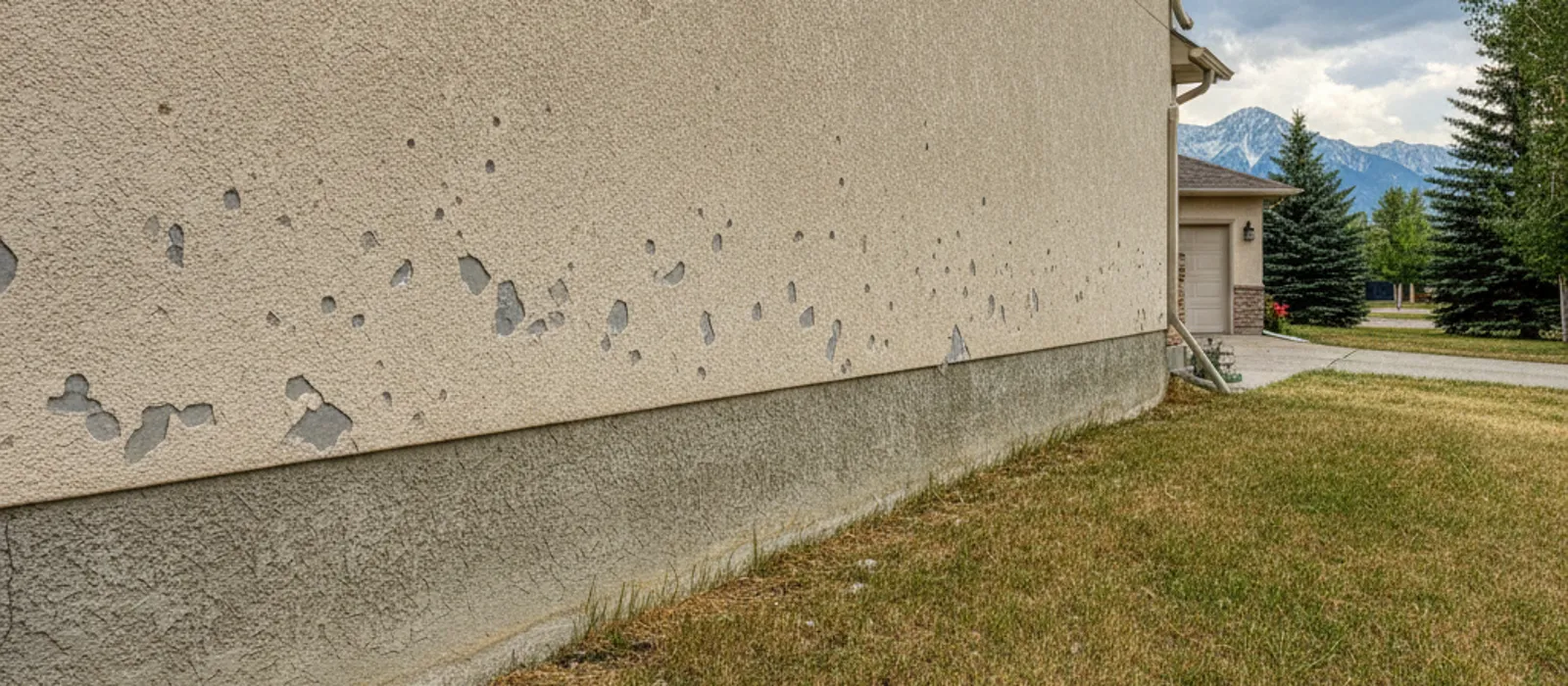
You walk the side of the house after a storm and find a scatter of small pockmarks on the west wall. Now you have to decide who to call first: your insurer, a contractor, or both. The order matters. So does knowing what hail damage in Calgary looks like on stucco, because a small dent and a long crack you can see from the street are not always the same problem, and the crack may have nothing to do with hail.
This guide covers what to check, what Calgary firms publish for repairs, and what to do before anyone touches the wall. Sandstone Stucco Co is an advertising and introduction service paid by independent Calgary stucco contractors. It does no repair work, and the contractor who quotes your job contracts directly with you.
If you would rather skip ahead, describe or photograph the damage through the contact form and an independent Calgary stucco contractor can send you a written, no-obligation quote. You can also call (403) 555-0148. Read on if you want to know what the contractor will be looking at.
What hail does to a stucco wall
The City of Calgary is direct about it: stucco is fire resistant and “will hold up well to flying debris in moderate wind and hail, but severe storms can cause damage.” The same page says stucco does not handle moisture well, and that moisture and snow can cause it to shrink and crack. So the thing to watch after a storm is less the dent itself than whether it gives water a way in.
Martini Stone Masonry, a Calgary contractor, says hail leaves 2 to 5 mm indentations that break the moisture barrier, and that hail is most common in July and August. That is the firm’s own claim, not a measured standard.
Calgary sits in what the City calls “hail alley”, the area that sees the most hail in Canada, and the City says all communities within Calgary are equally exposed. No part of the city gets a pass. What changes from storm to storm is where the hail falls and which side of your house faced it.
Stucco is built in layers. A traditional three-coat system specified by Imasco, a Surrey, BC manufacturer, has a scratch coat of at least 10 mm (3/8 inch) and a brown coat that brings the combined thickness to 19 mm, with a finish coat on top. Calgary Parging, another local contractor, puts it this way: “Stucco is designed to deflect water, not to be waterproof. The layer that actually keeps water out of your home is the building paper behind it.” A hail mark matters most when it reaches, or disturbs, what sits behind the finish.
How to check your walls for hail damage in Calgary
Start from the ground, with a phone camera and no ladder. Walk each side of the house when the sun is low and hits the wall at an angle, so small dents throw shadows. Flat overcast light and midday sun hide a lot.
Check these places in order:
- The wall that faced the storm. Look for a scatter of round or slightly oval marks of about the same size, spread across the wall rather than in a line.
- Soft metal. Dents in gutters, downpipes, vent caps and window flashings tell you hail hit the house, even when the stucco is hard to read.
- The finish coat. Look for chips that show a different colour or texture underneath, and small circular fractures where the surface has broken away.
- Window and door edges. Check the sealant and finish where the stucco meets the frame. Martini links gaps here to temperature movement, so not every gap at a frame is hail.
- The lowest 12 to 18 inches. Damage here can be a separate, older problem. Martini says snow piled against stucco softens and crumbles that band of the wall.
Photograph everything before you touch or wash anything. Take one wide shot of each wall, then close-ups with a coin or tape measure beside the mark for scale. Write down the date and time of the storm.
Don’t pressure-wash the wall to see the damage better. Weststar Wall Systems, a Calgary contractor, warns that high-pressure water can damage stucco and force moisture inside.
Cracks, dents and moisture: which marks matter
Not every mark on a wall is hail, and not every hail mark is urgent. A few minutes of looking can save you paying to fix the wrong thing.
Hail marks tend to be clustered, roughly round and similar in size. They sit on the side of the house that faced the storm, and you often find matching dents on metal nearby.
Temperature movement cracks are usually straight or stepped, and they show up at corners, at window and door frames, and where the wall changes plane. Martini says temperature movement can open 3 to 8 mm gaps where stucco meets frames. Imasco adds that some cracking and efflorescence are inherent to portland cement and are not a reflection of product quality.
Moisture warning signs are the ones to act on. Weststar lists soft or spongy areas and peeling or bubbling. Calgary Stucco and Slate is candid about the limits: “Nobody can tell you the full extent of water damage until the wall is opened up.”
Here is how the two get mixed up. Imagine a 1990s house with a hairline crack running from the corner of a basement window, and an owner who has just read about hail. One straight line from a window corner looks more like movement at the frame than hail, and a contractor might well price it as a window-perimeter repair. For that kind of job, Calgary Parging lists repairs around windows and doors at $975 to $3,000 before GST, and its April 2024 price list shows window perimeter repairs at $600 to $1,200 per window. Your own price depends on what is behind the stucco.
Total Exteriors, which publishes a repair-versus-replace guide, says repair fits when the damage is localized, moisture intrusion is minimal and has not spread, and the majority of the stucco is structurally sound. It says replacement fits when damage is widespread or structural, or moisture problems are extensive. For more on telling cracks apart, see when stucco cracks are worth worrying about and moisture behind stucco.
What stucco hail repair costs: Calgary firms’ published figures
There is no single price for stucco hail repair in Calgary. Each figure below is what one named firm publishes, and the firms price different things, so don’t add them up or average them.
| Item | Published range | Who publishes it | GST |
|---|---|---|---|
| Small patch repairs (chips, cracks, colour match) | $550 to $1,125 | Calgary Parging, reviewed May 2026 | Before GST |
| Medium repairs (2 to 3 areas) | $1,250 to $2,650 | Calgary Parging | Before GST |
| Section replacement (8 x 5 ft) | $3,700 | Calgary Parging | Before GST |
| Full wall remove and replace (9 x 30 ft) | $9,650 | Calgary Parging | Before GST |
| Colour match, added to a repair | $230 to $575 | Calgary Parging | Before GST |
| Scaffolding, upper storey or peaked sections | $4,000 to $12,900 | Calgary Parging | Before GST |
| Water-damaged sheathing replaced first | add $575 to $2,300+ | Calgary Parging | Before GST |
| One elevation stripped to the face, refinished in acrylic | $14,350 | Martini Stone Masonry, from its 2025 to 2026 estimates and invoices | Before GST |
| Small crack and spot repairs, “a very rough guide only” | about $300 to $1,500 | Calgary Stucco and Slate | Not stated |
Calgary Parging says its repair figures come from more than 1,360 written stucco repair estimates issued between 2020 and 2026, and that most repairs take 1 to 3 days depending on scope and weather. Its minimum service call is $550 to $690, before GST. Those are the firm’s own statements, and your wall may fall outside them.
Scaffolding is the line people forget. Say hail has marked the upper part of a two-storey wall. The marks are small, but reaching them safely can mean scaffolding, which Calgary Parging prices at $4,000 to $12,900 for upper-storey or peaked sections. The access can end up costing more than the patching. Ask any contractor whether access is in the quote and how it is priced.
For the wider picture, see the stucco repair cost guide for Calgary and the stucco repair page.
Insurance, permits and what to do first
Call your insurer before you book any repair. The City of Calgary says so plainly: “Before you do any repair work on your property, contact your home insurance provider.” The Insurance Bureau of Canada (IBC) says damage caused by hail and wind is typically covered by home, commercial and comprehensive auto insurance policies. Stucco isn’t named, so check what your own policy says.
IBC’s steps after hail make a good checklist:
- Assess and document the damage. Taking photos can be helpful.
- Call your insurance representative or your insurer’s claims department to report your damage.
- If possible, assemble proofs of purchase, photos, receipts and warranties.
- Keep damaged items unless they pose a health hazard.
- Keep notes and be as detailed as possible when documenting damage and providing information.
- Keep all receipts related to cleanup.
An adjuster is then assigned and may ask for a Proof of Loss form. IBC’s consumer line is 1-844-2ask-IBC (1-844-227-5422). The full steps are on IBC’s page on what to do after a hailstorm.
A contractor can give you a written repair estimate, and you may pass it to your insurer. The claim itself is between you and your insurer. Neither this site nor the contractors it advertises can promise a claim outcome. For the process in more detail, read how stucco hail claims work in Alberta.
Two other points sit alongside the claim. If your home is newer, check your new home warranty before paying for repairs. Alberta’s New Home Buyer Protection Act applies to homes built under a building permit applied for on or after 1 February 2014, and requires at least 5 years of cover for defects in the building envelope. Hail damage is not a defect, so don’t assume the warranty covers it.
On permits, the City of Calgary says that for most repair or replacement work you will not need a development or building permit. Replacing a component with a similar material that performs as well as, or better than, the original is allowed, and that includes exterior cladding. Confirm your own project with the City by calling 311, especially if you are thinking of changing the material.
The City’s hail and high wind page is also worth reading: City of Calgary, climate hazards: hail and high wind.
Choosing a contractor and signing the paperwork
After a big storm, contractors knock on doors. Alberta.ca’s advice: always insist on a written contract, get written estimates from more than one business, and make sure the contractor and tradespeople have Workers’ Compensation Board coverage.
A contractor who takes money before the work is finished, and who solicits, negotiates or concludes the contract in person away from its own premises, needs an Alberta prepaid contracting licence. You can check a licence with Service Alberta. Prepaid contracts over $200 must set out the quality or types of materials and the services and work to be carried out.
A contract negotiated at your home may be a direct sales contract. Under the Consumer Protection Act, a consumer may cancel one without any reason until 10 days after receiving a copy of the written contract, subject to the regulations. The City also says contractors need a valid City of Calgary business licence, and you can call 311 to confirm one.
Stucco is not a compulsory-certification trade in Alberta. The optional-certification trade that covers exterior finishes is Lather (Interior Systems Mechanic), so a contractor without a trade ticket isn’t breaking any rule. That puts more weight on the written scope and on references. Ask how the repair will be done, what will be opened up, and what the quote assumes about the wall behind.
If you are weighing a do-it-yourself patch against a contractor, stucco patching: DIY or a professional covers the trade-offs.
Colour matching and cold-weather limits
Most hail repairs are patches, and a patch has to sit next to older finish. Think of a faded 1990s acrylic finish on a house that is about to go on the market, where the owner wants the repairs to disappear. Calgary Parging says cement and acrylic finishes age and weather differently, and that on heavily weathered finishes a perfect match may not be achievable, in which case refinishing a full elevation is the option. Martini says matching an aged finish takes trial batches.
The manufacturer says much the same. Imasco notes that colour can vary with weather, texture, job conditions and method of application, and recommends buying the same colour batch number for the complete job. It warns that adding water will disturb the colour, and that separate batches should not go on side by side. Calgary Parging lists colour matching as an add-on of $230 to $575, before GST. Refinishing a whole elevation is a much bigger job: Martini prices one elevation stripped to the face and refinished in acrylic at $14,350, before GST.
Then there’s the weather. Imasco says to perform no stucco work when air and substrate temperatures are below 4 °C for 24 hours before, during and after application. It calls for moist curing for a minimum of 48 hours, no high-pressure spraying for 72 hours, and the finish coat after a minimum of 7 days. ADEX, another manufacturer, specifies its base coat and acrylic liquid coat at or above 5 °C for at least 24 hours.
Calgary Parging says stucco cures best above 5 °C in dry conditions, typically April through October, and that off-season repairs require heated hoarding. A winter repair may be limited, or priced differently. In the cold months, the sensible move is to photograph, report to your insurer, and have the written quote ready for spring.
If a bird is the problem instead, see the hail, woodpecker and stucco damage page. When you are ready, send photos and a short description through the form or call (403) 555-0148.
Frequently Asked Questions
How do I know if the marks on my stucco are hail damage?
Hail marks are usually clustered, roughly round and similar in size, and they sit on the side of the house that faced the storm. Dents in gutters or downpipes back that up. A long single crack at a window corner is more often movement, though only a contractor who inspects the wall can say for sure.
Should I call my insurer or a contractor first?
Call your insurer first. The City of Calgary advises contacting your home insurance provider before any repair work, and IBC’s steps start with documenting the damage and reporting it. A contractor can then give you a written repair estimate that you may pass to your insurer.
Is hail damage to stucco covered by my policy?
IBC says damage caused by hail and wind is typically covered by home, commercial and comprehensive auto insurance policies, but stucco is not named. Coverage depends on your own policy, your deductible and the insurer’s assessment. This site cannot tell you whether a claim will be approved.
Can stucco be repaired in the winter?
Manufacturers set temperature limits. Imasco specifies no stucco work when air and substrate temperatures are below 4 °C for 24 hours before, during and after application, and Calgary Parging says off-season repairs require heated hoarding. Ask the contractor what they would do and how they would price it.