
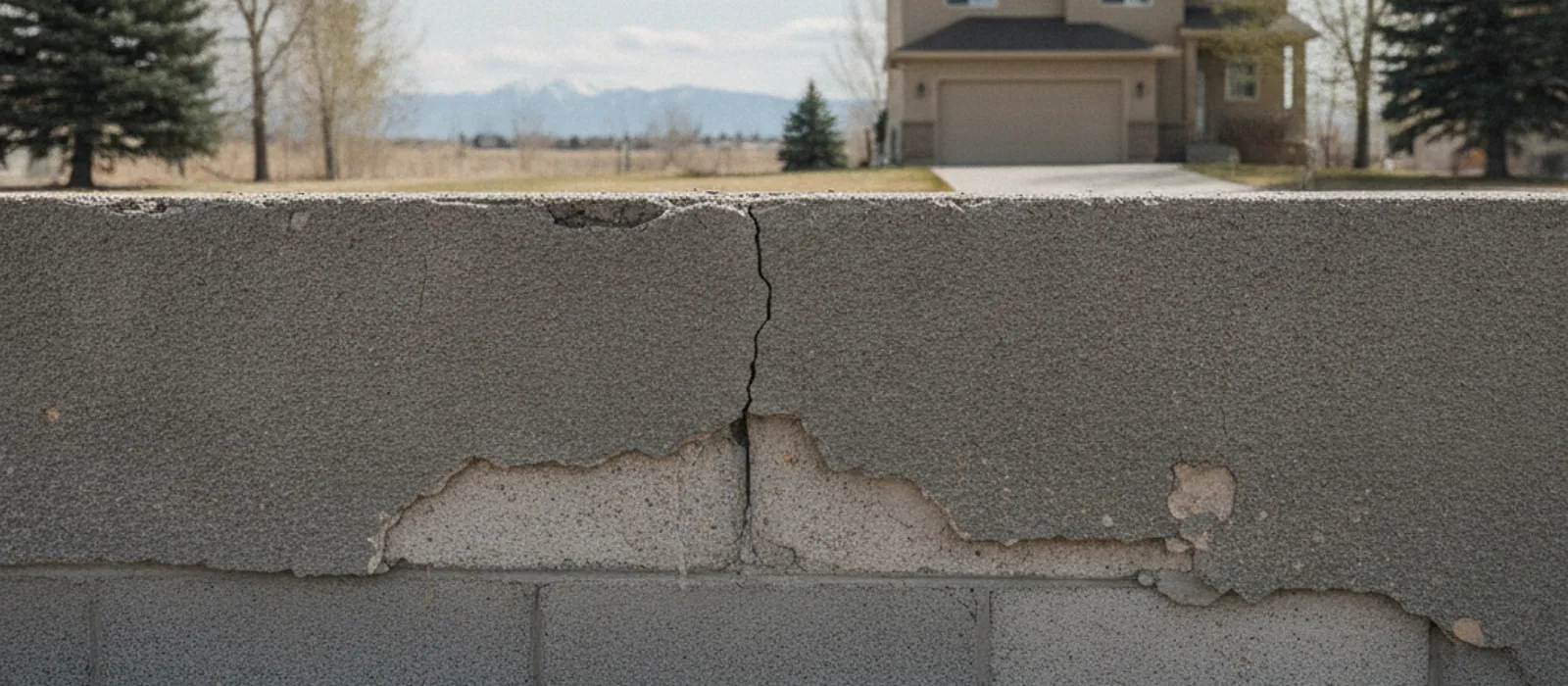
The grey coating along the bottom of your house is cracked, and a piece the size of a dinner plate dropped off last spring. Is this a repair of a few hundred dollars, or the first sign of something bigger? That depends on what parging is, what is behind it, and why it let go.
Parging is a cement-based coat trowelled onto the exposed part of a foundation wall, the strip between the ground and the bottom of your stucco or siding. It gives rough concrete or block a smooth, finished face. Sandstone Stucco Co is an advertising and introduction service paid by independent Calgary contractors, and it does no repair work itself. If you’d like a written, no-obligation quote, describe or photograph the damage through the contact form and an independent Calgary stucco contractor can look at it. You can also call (403) 555-0148.
What parging is, and what it is not
Parging sits on the part of the foundation you can see. On many houses it runs from the ground up to the base of the wall cladding, and on some it also covers garage walls and the edges of window wells.
Parging is a coating. It doesn’t hold the house up, and it won’t keep a leaking foundation dry. One Calgary contractor, Calgary Parging, says of stucco that it is “designed to deflect water, not to be waterproof,” and that the layer that actually keeps water out of the house is the building paper behind it. Parging and stucco are close relatives, both cement-based plasters, but parging goes straight onto a masonry wall instead of over framing, sheathing and paper.
Don’t confuse parging with the stucco above it. Calgary Parging said in 2024 that cement stucco with an acrylic finish is the main product on over 87% of residential properties, going by its own jobs, and stucco has its own repair options and prices. Parging sits closest to snow, splash and soil, so it’s often the first part of the wall to look worn.
Any parging problem comes down to one question: is the coating failing, or is the wall behind it moving or leaking? If it’s the wall, that isn’t a parging job at all. A later section comes back to this.
Why parging cracks and falls off in Calgary
Water and cold are a big part of it. Martini Stone Masonry, a Calgary contractor, describes water getting into small cracks, freezing at -20°C and expanding. That’s the firm’s own description, and it was written about stucco.
Calgary gives that cycle plenty of chances to repeat. The City of Calgary counted 117 freeze-thaw cycles in 2022, against a 30-year average of 128, and 54 chinook days against an average of 46. The figures are in the City’s 2022 climate hazards year in review.
The City also says stucco does not handle moisture well, and that moisture and snow can cause it to shrink and crack. Parging is made of similar stuff.
Contractors name a few other causes. Martini says snow piled against stucco softens and crumbles the lowest 12 to 18 inches of the wall, which on many houses is right where the parging meets the stucco. Calgary Parging said in 2024 that over 30% of its residential repairs address water damage caused by incorrectly installed rain gutters, eaves or flashing, so it’s worth checking where your downspouts empty. Martini also reports temperature movement opening 3 to 8 mm gaps where stucco meets window and door frames.
Some cracking comes with the material. Imasco, a cement stucco manufacturer, states that some cracking and efflorescence are inherent to portland cement and are not a reflection of product quality. A fine hairline crack that stays the same is a different matter from one that widens every winter.
When parging falls off in sheets
A crack is a warning. Parging coming off in pieces is further along: the coat has usually lost its bond with the wall behind it. Water that gets behind the coat and freezes can push it off in pieces rather than crack it in a line.
You can often find weak spots before they drop. Tap the surface lightly with a knuckle or a screwdriver handle. A hollow sound suggests that patch is no longer bonded, which a contractor can confirm on site. Weststar Wall Systems lists “soft or spongy areas” and “peeling or bubbling” as warning signs on stucco, and they’re worth looking for on parging too.
Two habits can make things worse. One is pressure washing: Weststar warns that high-pressure water can damage stucco and force moisture inside, and Imasco’s specification says not to spray walls with high-pressure water for at least 72 hours after application. The other is covering a failing patch with paint or a tube of caulk, which can hide the problem and hold water behind the coating.
Three situations and what they usually mean
These are hypothetical examples of the kind of job a Calgary homeowner might describe. They are not customer stories. Every figure is a published price range from Calgary Parging’s May 2026 guides, before GST.
A hairline crack under a basement window in a Signal Hill home. City community figures show 62% of Signal Hill’s dwellings were built between 1991 and 2000, so many of these walls have been through a lot of winters. Calgary Parging lists a hairline crack repair, at its minimum charge, at $345 to $520. The question that matters is whether the crack is only in the coating. If it’s fine, stays the same width and doesn’t run into the concrete, a patch is a reasonable first step.
Parging falling off in sheets along a Cochrane garage wall. A long run of loose coating on a garage wall points to the coat losing its bond, often because water is reaching the wall behind it. Calgary Parging lists garage parging with crack repair at $2,750 to $3,450; it’s a Calgary firm’s range, so a Cochrane quote may differ. A careful contractor will ask why the water is there, whether it’s a gutter, ground sloping toward the wall or something else, because re-coating without fixing the cause invites the same result.
A faded 1990s acrylic finish the owner wants to recolour before selling. This is mostly a stucco question, but stucco and parging meet at the foundation line. Calgary Parging lists an acrylic finish over parging at an extra $575 to $1,035, and a colour-match add-on for stucco repairs at $230 to $575. Imasco advises that colour can vary with weather, texture, job conditions and application method, and that the same colour batch should be used for the complete job.
What parging repair costs in Calgary
There’s no single Calgary price for parging and no honest average, only the published price lists of individual firms. The table below uses one firm, Calgary Parging, from its parging cost guide reviewed in May 2026. The firm says its figures rest on more than 1,360 written stucco repair estimates, and it states all prices before GST (5%). It isn’t a quote, and another contractor may price differently.
| Job (Calgary Parging, May 2026) | Published range, before GST |
|---|---|
| Hairline crack repair (minimum charge) | $345 to $520 |
| Small patch or chip repairs | $400 to $860 |
| Recoat, one side of the house | $975 to $1,700 |
| Recoat, full perimeter | $2,350 to $4,000 |
| Garage parging, with crack repair | $2,750 to $3,450 |
| Acrylic finish over parging (added cost) | $575 to $1,035 |
The same firm says most residential jobs wrap in one to two days. Access, loose material, an awkward spot or hidden water damage can all change the price, and the contractor won’t know the full scope until they see the wall. As Calgary Stucco and Slate puts it, “Nobody can tell you the full extent of water damage until the wall is opened up.”
Be most careful with lifespan claims. Calgary Parging says properly applied parging lasts 15 to 25 years, but that’s the firm’s claim, and drainage, exposure and workmanship all affect the result. For more detail, see what parging costs in Calgary and the parging service page.
When a crack is not a parging problem
Sometimes a cosmetic repair is the wrong answer. Parging can hide or reveal a foundation problem, but it can’t fix one. A stair-step crack, a crack that keeps growing, one side of a crack sitting proud of the other, or water coming through the wall into the basement can all be signs that the wall behind the coating needs a look from someone qualified to assess a foundation.
A qualified structural engineer is the right person to say what’s going on. Sandstone Stucco Co does not offer foundation crack repair, waterproofing, underpinning or structural work, and a parging quote covers the surface coating only.
If you can’t tell which side of the line you’re on, photograph the crack with a coin or tape measure beside it and note the date. Take the same photo again in a few months. A crack that hasn’t moved is a very different thing from one that has.
Two more checks before you spend money. If your home is newer, check your new home warranty before paying for repairs. The New Home Buyer Protection Act applies to homes built under a building permit applied for on or after 1 February 2014, and whether a particular parging problem counts as a defect is for the warranty provider to decide. And if hail or another insured event might be involved, the City of Calgary advises contacting your home insurance provider before you do any repair work.
Timing, cold weather and hiring a contractor
Parging is cement-based, so it has to cure. Manufacturer guidance for cement stucco is the nearest guide. Imasco says to perform no stucco work when air and substrate temperatures are below 4°C for 24 hours before, during and after application, and to keep it moist for at least 48 hours. ADEX, another manufacturer, calls for at or above 5°C for at least 24 hours for its base coat. Calgary Parging says stucco cures best above 5°C in dry conditions, typically April through October, and that off-season repairs require heated hoarding. Don’t accept a claim that a cement coat can go on in freezing weather.
So a crack you find in November is usually a job to plan for spring. Meanwhile, keep snow off the base of the wall, make sure downspouts empty well away from the foundation, and photograph what you see so the contractor has something to start from. The stucco repair cost guide covers how contractors price the wall above.
The Alberta government’s advice on hiring a contractor is practical: insist on a written contract, get written estimates from more than one business, and make sure the contractor and tradespeople have Workers’ Compensation Board coverage. The City of Calgary says contractors need a valid City of Calgary business licence, and you can call 311 to confirm one. A contractor who takes money before the work is finished, and who solicits, negotiates or concludes the contract in person away from its own premises (at your home, say), needs an Alberta prepaid contracting licence, which you can check with Service Alberta. Stucco and plastering are not a compulsory-certification trade in Alberta, so what you can check is the business licence, the prepaid contracting licence where it applies, the WCB coverage and the written contract.
A written quote should say what materials will be used and what work will be done. For parging, that means how loose material will be removed, whether the crack is being patched or the whole section re-coated, and how the finish will be matched. To start, send photos and a short description through the contact form, or call (403) 555-0148. Independent Calgary contractors quote and contract directly with you.
Frequently Asked Questions
Is parging the same as stucco?
They’re close relatives but not the same job. Both are cement-based coatings, but parging goes on the exposed foundation wall, while stucco is built up in layers over the wall above it. A quote will normally list them separately.
Why does my parging keep cracking in the same place?
A crack that keeps coming back in the same spot usually has a cause that hasn’t been dealt with, such as water running against the wall, a downspout emptying at the base, or movement in the wall behind. Patching the surface without fixing the cause tends to give the same result. If the crack widens or the two sides shift out of line, have a qualified engineer look at the foundation itself.
Can I repair parging myself?
A confident homeowner can manage small cosmetic patches, but the work needs the right temperatures and a properly prepared surface. A badly bonded patch can fall out again. A contractor can tell you on site whether a patch or a re-coat makes more sense.
How long does parging repair take, and can it be done in winter?
Calgary Parging says most residential jobs wrap in one to two days, though the scope decides it. Imasco says no stucco work below 4°C for 24 hours before, during and after application, and ADEX calls for at or above 5°C for at least 24 hours for its base coat. Calgary Parging says off-season repairs require heated hoarding, so winter work means hoarding or waiting for spring. Ask the contractor for a written timeline once they’ve seen the wall.